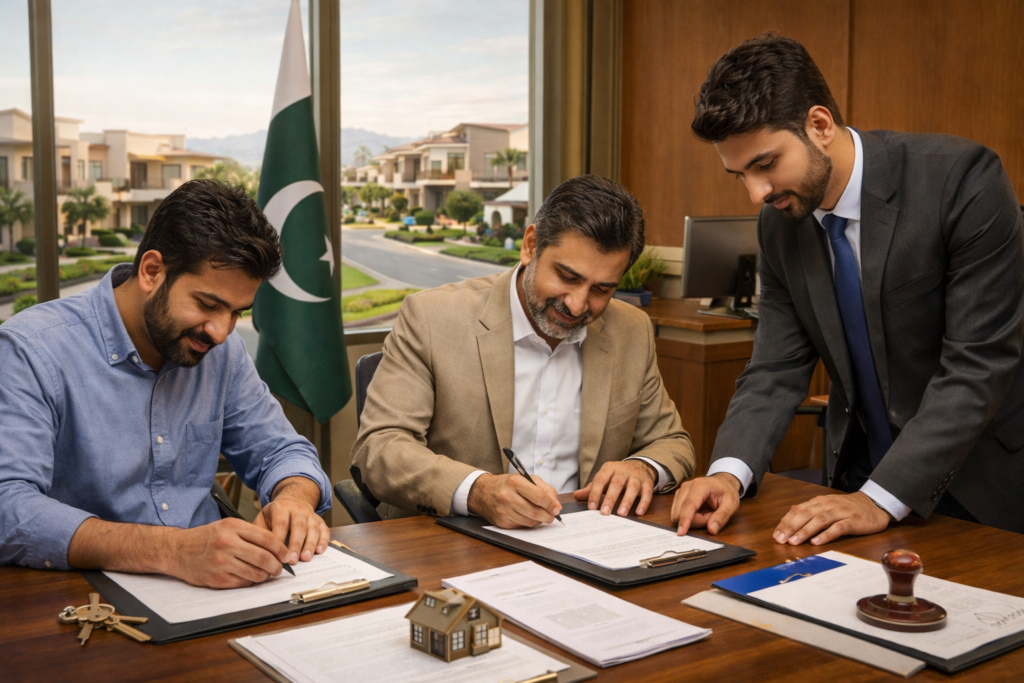
Introduction
Understanding the property transfer process in Pakistan is essential for anyone buying, selling, or inheriting property. Whether you are a first-time buyer, investor, or overseas Pakistani, following the correct legal procedure ensures your ownership is secure.
This guide explains:
-
property transfer procedure in Pakistan
-
how to transfer property ownership in Pakistan
-
property transfer process step by step
-
property transfer fees in Lahore and Karachi
-
legal documents and requirements
Property Transfer Process in Pakistan (Step-by-Step Guide for Buyers & Sellers)
.Its a step by step procedural guide, which helps buyers and sellers to how safely transfer the property and how they can avoid fake transfers and disputes.
Why This Process is Important
Property transfer is not just a transaction—it is a legal ownership change recorded in government records.
Key Reasons:
✔ prevents fraud and ownership disputes
✔ ensures legal protection
✔ required for resale and future investment
✔ mandatory for inheritance transfers
Best Cities for Property Transfer & Investment
Major cities with structured property systems include:
Lahore
Area Analysis
Well developed property infrastructure with LDA approved societies.
Property Price Range
| Type | Price |
|---|---|
| 5 Marla | PKR 2 – 3.5 Crore |
| 10 Marla | PKR 4 – 6 Crore |
Karachi
Area Analysis
Pakistan’s largest city with high demand and rental returns.
Property Price Range
| Type | Price |
|---|---|
| 5 Marla | PKR 1.2 – 2.5 Crore |
| 10 Marla | PKR 3 – 5 Crore |
Sindh
Area Analysis
Different transfer process (registry & mutation system varies slightly).
Property Transfer Process in Pakistan (Step-by-Step)
Here is the complete process of property transfer:
Step 1: Verify Property Documents
Check:
-
Original registry/title deed
-
Seller CNIC
-
Property tax record
-
Society NOC
Step 2: Agreement Between Buyer & Seller
-
Prepare sale agreement
-
Finalize price
-
Pay token amount
Step 3: Prepare Transfer Deed
This legal document includes:
-
buyer & seller details
-
property description
-
agreed price
Who prepares the transfer deed?
Usually a lawyer or property agent.
Step 4: Pay Property Transfer Fee
Fees vary by city:
Property Transfer Fee in Karachi
-
Stamp duty
-
Capital value tax
-
registration charges
Property Transfer Procedure in Lahore
-
DC rate-based taxes
-
filer/non-filer tax difference
Step 5: Visit Sub-Registrar Office
This is where ownership is legally transferred.
Where do you register property?
-
Sub-Registrar Office
-
Land Revenue Department
Step 6: Biometric Verification
-
Buyer and seller must verify identity
-
Thumb impression required
Step 7: Property Registration & Transfer Completion
After approval:
✔ ownership officially transferred
✔ buyer receives registry documents
🏠 Need help with property transfer?
✔ Legal document verification
✔ Transfer fee estimation
✔ Safe ownership transfer
👉 Contact our experts for secure and hassle-free property transfer assistance
Budget Breakdown (Transfer Costs)
Typical Transfer Costs
| Cost Type | Estimate |
|---|---|
| Stamp Duty | 3–5% |
| Registration Fee | 1% |
| Agent Commission | 1–2% |
| Taxes | Varies |
How to Transfer Property from Father to Son in Pakistan
This is a common query:
Process:
-
Prepare gift deed (Hiba)
-
Register at sub-registrar office
-
Complete biometric verification
This method is often used to avoid complex sale procedures.
Property Transfer Laws in Pakistan
Property transfers are governed under:
-
Transfer of Property Act Pakistan
-
Land Revenue Act
-
Local development authority rules
How to Transfer Property Ownership in Pakistan Online
Currently, full online transfer is limited, but:
✔ online record verification is available
✔ digital property portals assist with listings
✔ future systems may enable full online transfers
Pros and Cons of Property Transfer System
Advantages
✔ legal ownership protection
✔ transparency
✔ secure transactions
Disadvantages
• time-consuming process
• multiple fees
• documentation complexity
Tips Before Property Transfer
Follow these expert tips:
-
Verify all documents before payment
-
Confirm seller ownership
-
Check society approval
-
Calculate total transfer cost
-
Avoid dealing without legal agreement
Future Development & Digital Transformation
Pakistan is moving toward:
✔ digital land records
✔ online verification systems
✔ improved transparency
This will make property transfer faster and safer in the future.
📞 Ready to Transfer Property Safely?
We help you:
✔ complete legal transfer process
✔ verify ownership documents
✔ calculate transfer costs
✔ avoid fraud and mistakes
👉 Contact us now for professional property transfer consultation
Property Transfer Rules, Process, Cost and Family Transfer in Pakistan
What are the rules regarding transfer of property in Pakistan?
The basic rule for a legal property transfer in Pakistan is that the ownership transaction must be properly documented, the parties must be identified and verified, applicable government taxes and fees must be paid, and the transfer must be recorded with the relevant land-record, registration authority, development authority or housing society. The exact requirements depend on whether the transaction is a sale, gift, inheritance, transfer within a housing society, or another legally recognized form of transfer.
For a sale transaction, buyers should verify the seller’s ownership, obtain the relevant Fard or ownership record, check the original registry and previous transfer documents, confirm that the property is free from undisclosed disputes or encumbrances, and verify that the housing society or development authority has approved the property and permits its transfer. In Punjab, the Punjab Land Records Authority (PLRA) provides systems for registry and mutation, while its Property Transfer System can be used by relevant societies and authorities to process property transfers.
The transfer should not be treated as complete merely because money has been paid or a private agreement has been signed. The appropriate registered deed, mutation/intiqal, society transfer record, or other legally required ownership record should be completed according to the nature of the property and transaction.
What are the steps to transfer a property in Pakistan?
Although the exact procedure varies by location, a typical property transfer process follows these steps:
- Verify ownership and property documents: Check the seller’s CNIC, ownership record/Fard, registry, mutation or allotment/transfer documents, property number and other relevant records.
- Verify the property itself: Confirm the exact plot, house, apartment or commercial unit, its location, area, boundaries and current ownership status. For housing societies, also verify the society’s approval status and whether the particular block, phase or property is transferable.
- Check outstanding liabilities: Confirm whether there are unpaid society dues, utility charges, property taxes, mortgages, court disputes or other restrictions affecting the transfer.
- Prepare the sale, gift or other transfer deed: The document should correctly identify the parties, consideration where applicable, property details and terms of the transaction.
- Calculate applicable government dues: Depending on the transaction, these may include stamp duty, registration charges, mutation charges, CVT or other provincial/local charges, as well as applicable federal taxes.
- Generate and pay the required challans: In Punjab, the e-Stamping system can calculate applicable stamp duty, CVT and related charges, while the registry process incorporates applicable government payments.
- Complete registration or society transfer: The buyer and seller, along with witnesses where required, complete the relevant verification and documentation process before the competent authority.
- Complete biometric verification: Where required, the parties undergo biometric verification. Punjab’s PLRA states that biometric verification forms part of its mutation and property-transfer procedures.
- Complete mutation/intiqal: After the transaction is verified and approved, the new owner’s name is entered into the official land record where mutation is applicable.
- Collect and verify the final documents: Obtain the registered deed, mutation/Intiqal, transfer letter, allotment document or other applicable ownership evidence and verify that the records correctly show the new owner’s details.
For Punjab land records, PLRA describes mutation (Intiqal) as the official process of updating the government land record after a sale, inheritance, gift or court order.
How much does it cost to transfer property in Pakistan in 2026?
There is no single fixed property-transfer cost for all of Pakistan. The total amount depends on the province, property location, property value or applicable valuation, transaction type, taxpayer status, property category and whether the property is being transferred through a housing society, development authority or the land-record system.
A typical property transfer may involve some combination of:
- Stamp duty
- Registration fee
- Mutation/Intiqal fee
- Capital Value Tax (where applicable)
- PLRA or land-record service charges
- Housing society/development authority transfer charges
- FBR advance income tax or other applicable taxes
- Documentation, legal or professional charges
In Punjab, the official PLRA service charge notification currently lists a Rs. 2,000 PLRA service charge per transaction for transfers in cooperative societies, development authorities and private housing schemes, while government fees are separately determined by the applicable authorities. This should not be confused with the total cost of transferring a property.
Property valuation also matters because Punjab’s official DC Valuation system is used as a basis for calculating stamp duty, registration fees and other government charges.
Federal advance income tax can also significantly affect the transaction cost. FBR’s current rate information shows that Sections 236K and 236C apply to buyers and sellers respectively, with rates varying according to property value and filer/late-filer/non-filer status. Because tax rates can change through annual Finance Acts, buyers and sellers should calculate the applicable amount from the latest FBR rate card rather than relying on an old percentage published online.
Therefore, the safest answer to “how much does it cost to transfer property in Pakistan?” is: calculate the applicable provincial government charges, registration/mutation costs, society charges and current FBR taxes based on the property’s location and transaction value. A fixed nationwide percentage can be misleading.
What is the best way to transfer property to family members?
The appropriate method depends on why the property is being transferred and whether money is changing hands.
If a parent genuinely wants to give a property to a child or another family member without receiving a sale price, a properly documented gift (Hiba/gift deed) may be more appropriate than disguising the transaction as a sale. If the family member is actually purchasing the property, the transaction should generally be documented as a sale rather than inaccurately describing it as a gift.
For an inheritance, the transfer should follow the applicable inheritance and succession process rather than being treated as an ordinary sale. Similarly, transferring property between family members through a housing society may require the society’s own transfer application, verification, clearance certificate and transfer fee in addition to government documentation.
Regardless of the relationship, do not rely only on a private family agreement or an informal undertaking. Complete the legally required documentation and update the relevant ownership record so that the new owner’s title is properly reflected in the official record. In Punjab, PLRA recognizes sale, inheritance and gift among the transactions that can result in mutation of the land record.
In simple terms: if you are gifting property to a family member, use the legally appropriate gift mechanism and complete the required registration/mutation or society-transfer formalities; if you are selling it to a family member, document it as a genuine sale and complete the normal transfer procedure.
Important: Property laws, taxes, stamp duty, registration charges and procedures can change and differ between Punjab, Sindh, Khyber Pakhtunkhwa, Balochistan, Islamabad Capital Territory and individual housing societies. Before completing a high-value transaction, verify the current charges and requirements with the relevant land authority, registrar, housing society and tax authority, and consider obtaining advice from a qualified property lawyer.
Verify RDA Approval Before Transferring Property
Before completing a property purchase or transfer in Rawalpindi, buyers should confirm that the housing scheme and the specific property are legally approved and transferable. Our detailed RDA Approved Societies List 2026 explains how to check approved housing societies, understand RDA approval status, and verify a society before investing in a plot, house or apartment in Rawalpindi. This verification is especially important when purchasing property in a new or developing housing scheme.
Check Illegal Housing Societies Before Buying
If you are considering a property in Rawalpindi or surrounding areas, also check the latest RDA Illegal Housing Societies List 2026 before paying an advance or signing a sale agreement. Our guide explains how to check RDA non-approved and illegal housing schemes, understand warning signs, and verify the current status of a society online. Completing these checks before the property transfer process can help buyers avoid purchasing property in an unauthorized scheme or an unapproved extension.
Find Property and Complete Your Transfer with Confidence
Understanding the property transfer procedure in Pakistan is only one part of a safe real estate transaction. Buyers should also verify ownership documents, seller identity, society approval, outstanding dues, transfer eligibility and the applicable registration and tax requirements before making payment.
After completing these checks, PropertyPerl can help you explore verified property listings in Rawalpindi, Islamabad, Lahore and other major Pakistani markets, including plots, houses, apartments and commercial properties.
Whether you are buying your first home, investing in a residential plot or selling an existing property, you can use PropertyPerl to discover current property opportunities and connect with genuine buyers, sellers and agents.
Visit PropertyPerl to search property for sale in Pakistan and compare available opportunities before taking the next step in your property transaction.
FAQ’s
1. What is the process of transfer of property?
It includes verification, agreement, transfer deed, fee payment, and registration.
2. How to transfer property ownership in Pakistan online?
Currently limited to record verification; full transfer requires physical registration.
3. What is the easiest way to transfer property?
Through proper legal registration or gift deed (for family transfers).
4. Who pays transfer fees?
Usually the buyer, but it can be negotiated.
5. What is the best way to transfer property to my son?
Through a registered gift deed (Hiba).
6. Which property cannot be transferred?
Disputed, illegal, or non-approved society properties.
7. Who prepares the transfer deed?
A lawyer or property agent.
8. What happens when you transfer a property?
Ownership legally changes to the buyer.
9. Who deals with property transfer?
Lawyers, agents, and government registrars.
10. What is the property transfer fee in Karachi?
It includes stamp duty, CVT, and registration charges.